
Titanium vs Acetate Glasses: Which Frame Material Suits You?
Titanium or acetate? Compare weight, comfort, colour, durability and fit to choose the right glasses frame material, with examples from our Melbourne studio.
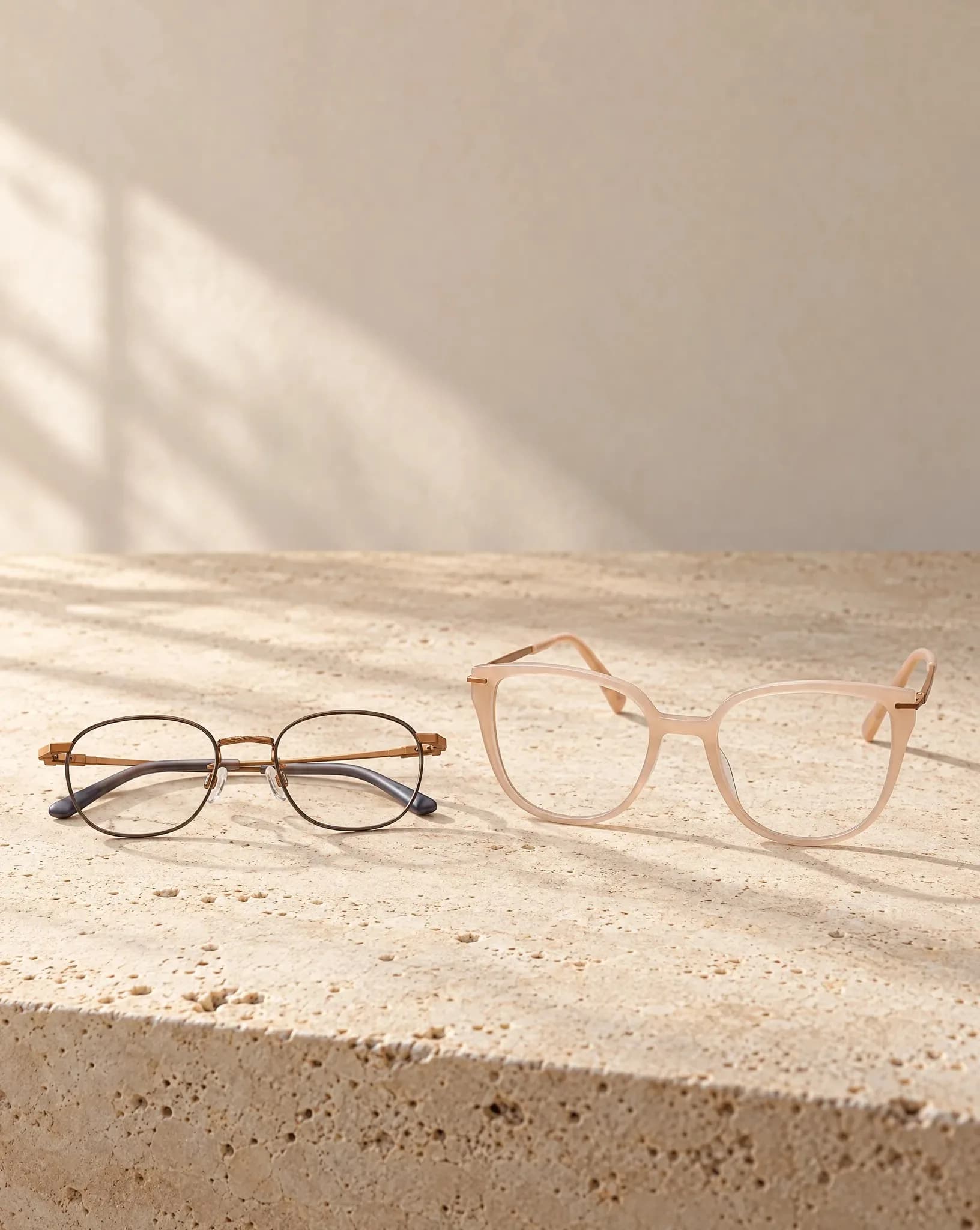
Choosing new glasses usually starts with shape and colour. The question that decides how they feel to wear every day comes a little later: what are they made of? Titanium and acetate are the two materials most often recommended for quality eyewear, and they could hardly be more different. At RYAN ADDA, designing frames in Melbourne, Australia, we work with both, and often combine them in one frame. Here is how to decide which suits you.
Why Frame Material Matters
Frame material affects almost everything you notice after the first week of wearing: how much the frame weighs on your nose, how it holds its shape, how it responds to heat and sweat, how much colour it can carry, and how easily an optician can adjust it. There is no single best material, only the right one for your face, your skin and your day.
What Is Titanium?
Titanium is a metal known for being both strong and light. Our titanium is sourced from Japan, and on our all-titanium frames it is paired with hinges made in Germany.
What titanium does well:
- Lightweight comfort: Its low density means a titanium frame sits lightly on the nose and ears, which makes it a natural choice for all-day wear.
- Strength in a fine profile: Titanium holds a slim, precise line without feeling fragile, which is why it suits minimal designs such as our ME and ZEN collections.
- Corrosion resistance: Titanium resists corrosion, so it copes well with sweat, humidity and Australian summers.
- Adjustability: A titanium frame can be finely adjusted by an optician to suit your face, and most titanium designs use adjustable nose pads.
- Kind to sensitive skin: Pure titanium contains no nickel, the most common cause of metal allergy from glasses.
The trade-offs: titanium is usually more expensive than acetate, and its colour comes from surface finishes rather than through the material itself, so the palette is more restrained.
What Is Acetate?
Cellulose acetate is a plant-based plastic made from wood pulp or cotton. It is made in blocks or sheets, which are then cut, shaped and polished into frames. That process is what gives acetate its signature look.
What acetate does well:
- Depth of colour: Colour runs through the material rather than sitting on the surface. Layers of coloured acetate create translucent tones, tortoiseshells and gradients that no metal finish can match.
- Presence: Acetate supports thicker, bolder shapes with real character, ideal if you want your frames to make a statement.
- Warm, comfortable feel: Acetate is pleasant against the skin and has a satisfying, substantial feel without being heavy.
- Flexible and durable: Good acetate flexes under pressure rather than snapping, and stands up well to daily use.
- Easy to adjust: An optician can gently warm acetate to reshape it for a better fit.
The trade-offs: acetate frames have more mass than titanium, and because acetate is warmed to adjust, it is best kept away from very high heat (such as a car dashboard in summer).
Titanium vs Acetate at a Glance
- Weight: Titanium is lighter for its strength. Acetate feels more substantial on the face.
- Look: Titanium reads fine, precise and minimal. Acetate reads bold, colourful and expressive.
- Colour: Titanium has a restrained palette of metal finishes. Acetate offers a near-endless range of colours and patterns.
- Durability: Both are durable. Titanium is especially resistant to corrosion and fatigue.
- Sensitive skin: Pure titanium is nickel-free, and acetate is widely recommended for metal-sensitive skin.
- Adjustment: Titanium adjusts through its metal and nose pads, acetate through gentle heat.
The Best of Both: Titanium and Acetate Together
You do not always have to choose. Many of our frames combine the two materials, putting each where it performs best: acetate where you want colour and presence, titanium where you want lightness and strength.
Our FLIGHT collection is built this way. The FLIGHT DIRECTOR pairs Japanese titanium with acetate in six translucent tones, from Cadet and Sapphire Pebble to Blush, Ivory and Peach Rose. Our UMAMI collection, including the UMAMI WASABI, uses the same pairing, as do frames such as the ONE COSMOS and ONE LEAGUE.
Which Should You Choose?
Choose titanium if you wear glasses all day, prefer a light and minimal frame, have sensitive skin, or want something that looks quietly refined. Start with our ME collection, such as the ME PARIS, or the ZEN DREAMER.
Choose acetate if you want colour, pattern and a frame with presence, or you are buying sunglasses with a bold shape. Our OO sunglasses, such as the OO YOLO, are cut from acetate.
Choose both if you want colour at the front and lightness everywhere else. Look at the FLIGHT and UMAMI collections.
Whichever you choose, try frames on in person. An independent optician can check the fit, adjust the frame and dispense your prescription properly.
From our studio in Melbourne, we design every RYAN ADDA frame around how it feels as much as how it looks. Explore the full collection at https://ryanadda.com/shop, filter by material, and find a stockist near you to try them on.
FAQ
Are titanium glasses worth the extra cost?
If you wear glasses all day, often yes. Titanium's light weight, strength and corrosion resistance mean a well-made frame stays comfortable and holds its shape for years. If colour and bold shapes matter more to you, acetate is excellent value.
Is acetate the same as plastic?
Acetate is a type of plastic, but it is plant-based, made from wood pulp or cotton, and quite different from the injection-moulded plastics used in cheaper frames. It is cut and polished from layered material, which gives it depth of colour and durability.
Which is better for sensitive skin, titanium or acetate?
Both are good choices. Pure titanium contains no nickel, and acetate is widely recommended for metal-sensitive skin. If you have a diagnosed nickel allergy, check every part of the frame, including hinges and nose pads, with your optician.
Can titanium and acetate frames be adjusted?
Yes. An optician adjusts titanium frames through the metal and the nose pads, and acetate frames by warming the material gently and reshaping it.

